Dev Log #1: Why I'm Building Key Lingo
My story and the dream I hope to make a reality.
What is Gambit Games?
This name goes back to my college days when a friend and I joined a 48 hour hackathon. The goal was to build an application using open source datasets. Our idea was a Candy Crush-like game where you want to create a balanced meal without accidentally binge eating.
The judges seemed to really enjoy our idea but were not a fan of our team name, Bit Chess. They suggested we change it, but we were young, naive, and running on very little sleep, so we declined the option. We did not place at all, but in hindsight, we probably would have if we had simply changed our team name. I wish I still had access to the source code of Healthy Foods but alas it has been lost to time.

Gambit Games is a nod to that original name and how much I have matured since then. The name is still relevant today as Chess has recently become an interest of mine. I prefer to make risky moves with opening lines like the King’s Gambit. I want to take the same risks in the games I choose to make and let passion lead my decisions.
Who Are You?
Ever since I graduated college I have been dedicated to building an effective language learning application. At first, I started with Lexicon, an app similar to Duolingo. Structured lessons containing word-for-word translations, using words that seemed random and irrelevant to everyday life.
I continued to refine Lexicon nights and weekends, helping me to improve and expand my programming knowledge. Over time I built skills like frontend, backend, and infrastructure. There was always something new to learn around every corner.
For years, spaced repetition, rote memory, and mnemonics seemed to be the only way to effectively learn a new language. It wasn’t until I heard about comprehensible input, the natural method, and Automatic Language Growth that I started considering alternative approaches to language learning. Both Dr. Stephen Krashen and Dr. J. Marvin Brown believe anyone can achieve near-native fluency by subconsciously absorbing a language through massive amounts of “comprehensible input”.

These ideas strongly influenced the future direction of Lexicon as I started reviving the contents of books by Arthur Jensen (English by the Nature Method), Ivor Armstrong Richards, and Christine Gibson (English Through Pictures). This turned Lexicon into a puzzle game where you have to intuit the meaning of words and phrases based on context and visual cues. The only problem was that although it was fun for me, it wasn’t everyone’s cup of tea.
What Is Your Idea?
The idea for Key Lingo came to me about a year ago. I originally built a prototype in Godot of a simple keyboard-based game where animals would move down the screen. You would have to type the names of the animals to defeat them and do it quickly before you were overwhelmed.
I started to wonder how I could teach more words, especially verbs, so I made my next micro game. Before I knew it, the mechanics started to resemble WarioWare, and I realized that if I approached it correctly, I could get spaced repetition and comprehensible input working together in a fun way. The scenes and characters are whimsical enough to keep their attention, and typing the words while watching how they play out is what helps them stick in your memory without you even realizing it.
Who Wants This?
Most language learning apps fall into the same trap. They try to meld language learning with game mechanics, but they don’t seem to understand what makes either one fun. They just give you the answers and expect you to memorize them, and most of the “games” in this space are really just language learning apps with extra steps. I don’t know about you, but I don’t want to test my memory to get to the fun. I want the memorization to be the fun.
Duolingo is the one everyone knows: hearts, a skill tree, a leaderboard, where the vocabulary is second to the loop of showing up just to protect your streak. Rosetta Stone and Drops teach through pictures instead of translation the same way the natural method does, but neither one is a game you’d choose to play. Pimsleur skips the screen entirely. It’s just a voice and spaced repetition for the twenty minutes you spend in the car, and there’s no interactivity beyond talking back to a recording.
In terms of games, Pierre’s Adventures in French is a really well executed one. It’s not that different from switching your favorite game’s language and learning to say “I took an arrow to the knee” in another language. The only thing holding it back is its limited replayability and lack of recall exercises. I also like channels like English from the Ground Up, a language learning channel with the primary medium being games. It’s nicely produced but needs a bit more structure and ways to keep the viewer engaged.

It is very clear to me that there is a market for this kind of game. When Fluyo burst onto the scene with its Kickstarter raising $1.2M from over 8,000 backers in a single month, it became the most-funded app and mobile game in Kickstarter history. It had me thinking it was the answer to language learning. It was being led by an influential YouTuber who seemed to have a good idea of how to learn languages effectively. I thought I could never compete with them, but after a few years the hype died down, as it turned out to be more style over substance.
What Are The Mechanics?
Key Lingo is a keyboard-driven minigame compilation built in Godot. The premise: what if learning vocabulary in a new language felt like playing a game instead of grinding flashcards?
These are the main mechanics that I think will help Key Lingo succeed where other language learning apps have failed:
- Keys are the only input. You feel every letter as you type it and really map the shape of it to your memory. No need to fumble between mouse and keyboard.
- WarioWare-style pacing. The fast cuts keep you engaged for longer, and help you to improve more skills than just a new language.
- A spaced-repetition scheduler underneath it all. Games aren’t just random, they’re chosen just in time before you forget the meaning of a new word.
- Mnemonics baked into the presentation. Wacky characters and situations help words to stick with you.
I want Key Lingo to be a game that is still fun even if you know the language. I also want to add secret advanced sections for people who are really dedicated to learning their target language.
Why Godot?
I’m a web developer by trade, so it would have been a safe option to build this as a web app, since I already know the tools. But I wanted my distribution to be flexible: Steam, itch.io, desktop, web, and maybe even mobile (if I’m clever enough), without redoing everything multiple times to get there. Godot 4 fit that goal, and GDScript is close enough to Python that picking it up felt very natural.
Each minigame lives on its own, separate from the system that tracks the vocabulary you’re learning. That way I can build new games in isolation without breaking anything else in the process.
In the early prototyping I had some trouble setting up the text-to-speech voices and kept accidentally choosing the wrong voices. I was surprised by some of the voice options I had which included a robot voice. It’s not really the vibe I’m going for, but it was a good laugh. I do plan to work with professional voice actors for the final game so this would not be a problem for the final build.
What It Looks Like Right Now?
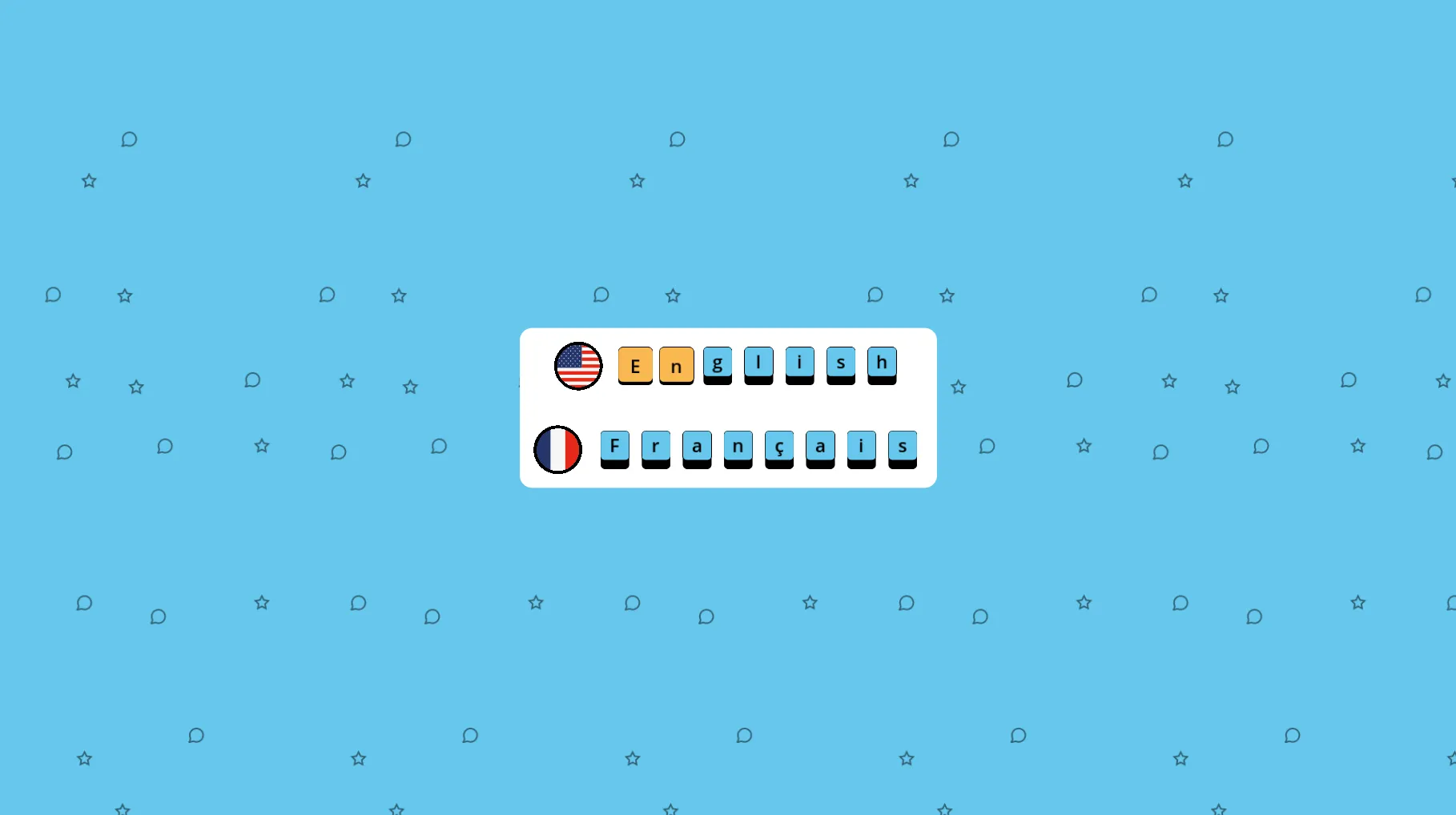
You can play what I have so far on itch.io, right in your browser, no download necessary. There are four scenes in total, though I’m only sharing screenshots of two of them here since those are the ones that got the professional art treatment. The first is a basic welcome screen that lets you pick a language, currently English or French, with more planned:
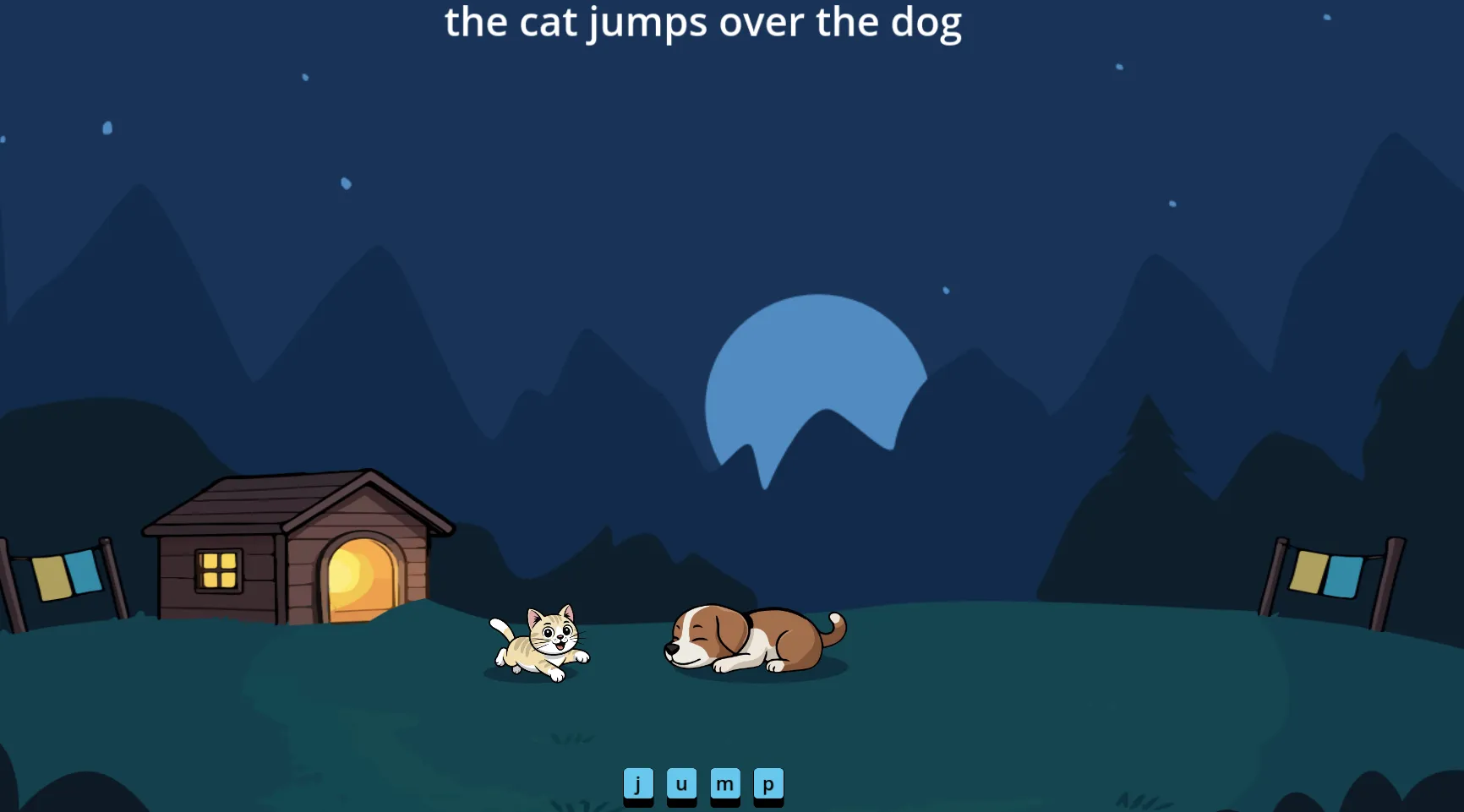
The other is from a verb mini game, though there are more verb and word attack games not pictured here yet.
What about AI?
A reasonable question I am sure most people are curious about is the use of AI in the project. I am a programmer by trade so I don’t plan to vibe code the project. However, I will use AI to generate code if it is a simple or mundane task. I will also use it to generate placeholder assets. This approach will help make sure I focus my efforts on the most important parts of the project first.
Once the project is more mature I will either hire freelancers to do the art, music, and voice overs or do them myself where it makes sense. I have already paid for some professional art to be made for the game. I hope this gives you a sense of the art direction I am going with Key Lingo.
Between that freelance art and the Steam Direct fee, I’ve already put almost $500 into this project. I want to set a budget that scales with the interest in this project, but I wanted to make this initial investment to show how committed I am to it.
Where Do Things Stand Now?
I have been hard at work building the initial presence of Gambit Games and Key Lingo. The studio’s socials are live, my Kickstarter page is up even though the campaign itself hasn’t launched yet, and the Steam page for Key Lingo is live too. My goal for the next milestone is to create another mini game, add more words, and polish the word attack game that’s already up and running.
In terms of cadence of posting, here’s where I plan to share, and how often:
- Newsletter: usually whenever I post a new dev log.
- Discord: the day-to-day hub for testers and backers, most days.
- YouTube: dev log videos and trailers, roughly monthly.
- Twitch: live build streams, roughly weekly.
- Bluesky: quick text updates and thoughts, several times a week.
- Instagram: the visual highlight reel, roughly weekly.
- Reddit: mostly lurking, with the occasional post to promote a real milestone.
- Game Jolt and itch.io: a copy of each dev log goes up here too, along with updates whenever a new build or demo is ready.
- Ko-fi: a copy of each dev log goes up here too, otherwise quiet unless there’s a support perk or milestone worth flagging.
- Kickstarter: backer updates tied to funding milestones and builds.
- Steam: a copy of each dev log gets posted as Steam news too, otherwise mostly static until there’s a wishlist push, demo, or release date to announce.
- Twitter/X: I reserved the name and that’s it. I’m not posting there.
What Can I Do?
If you want to help my dream become a reality, the most powerful thing you can do is to wishlist Key Lingo on Steam and follow my Kickstarter page so you’re notified the moment the campaign goes live. Follow my progress on your preferred social channels and share it with anyone you think might be interested. If you want more direct updates, sign up for the newsletter, where I’ll share my progress every month.
If you have more to give, I’ve set up a Ko-fi account to take donations while I wait to launch the Kickstarter campaign, and I’ll personally match anything given there. My personal budget will also scale with interest in the project. I’m already over budget at the moment, but I’m confident people will show up, and I want to show that I’m as invested in this project as you are.